Obral!

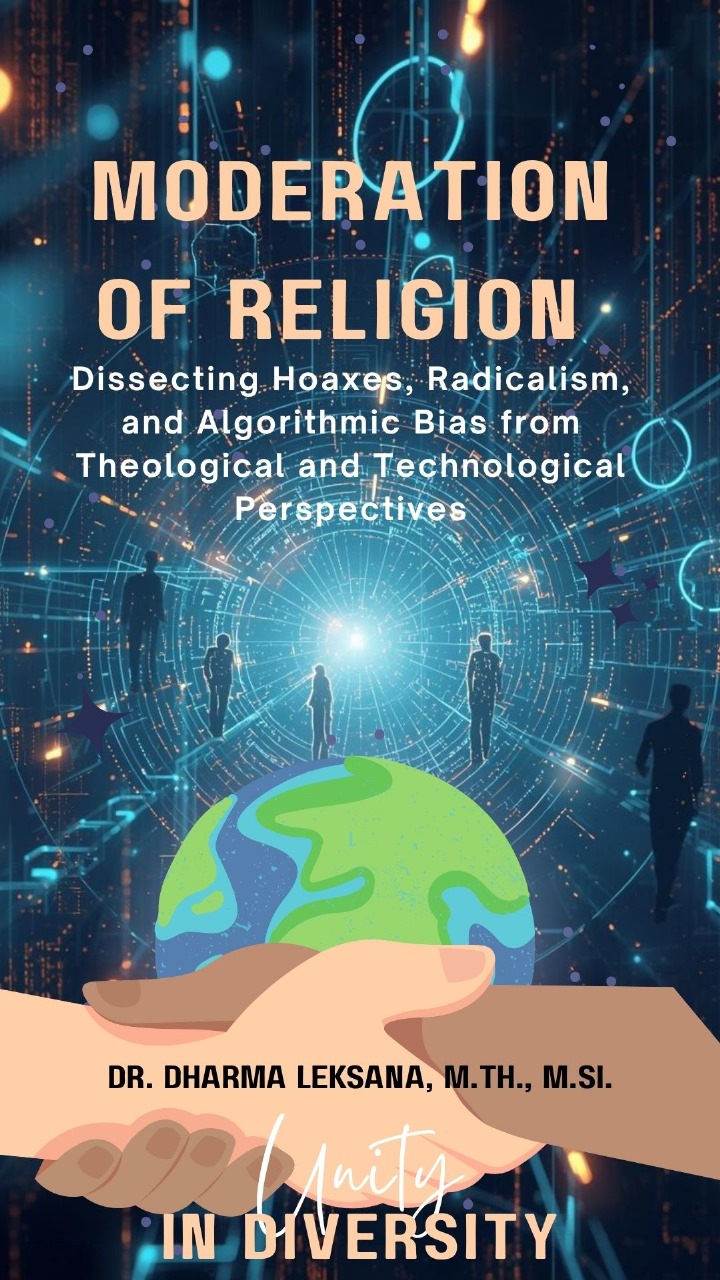
Moderation of Religion in the Age of Information Disruption: Dissecting Hoaxes, Radicalism, and Algorithmic Bias from Theological and Technological Perspectives

Harga aslinya adalah: Rp280.000.Harga saat ini adalah: Rp200.000.

Moderation of Religion in the Age of Information Disruption

Mengurai Hoaks, Radikalisme, dan Bias Algoritma dari Perspektif Teologis dan Teknologis


Tesis Utama: Agama sebagai Vaksin Spiritual Melawan Infodemic


Buku ini menawarkan sintesis langka antara teologi, filsafat, dan teknologi, menjawab pertanyaan mendasar: bagaimana manusia dapat mempertahankan keutuhan moral dan spiritual di tengah disrupsi informasi?5.


Penulis, Dr. Dharma Leksana, berargumen bahwa Moderasi Beragama di era digital bukanlah sekadar program akademik atau kompromi ideologis, melainkan sebuah disiplin moral 6dan tanggung jawab spiritual abad ke-21 7untuk memastikan agama tidak menjadi senjata kebencian atau alat propaganda digital8. Inti dari proyek ini adalah upaya untuk “merehumanisasi teknologi” dan menegaskan kembali martabat spiritual manusia di tengah jaringan9999.


Disrupsi informasi telah menciptakan paradoks: konektivitas tanpa kedalaman, kebebasan berekspresi tanpa kearifan, dan iman yang terjebak dalam echo chamber dunia digital10. Moderasi Beragama, dalam konteks ini, berfungsi sebagai “vaksin spiritual melawan infodemic—mengajarkan bukan hanya apa yang benar, tetapi bagaimana memperlakukan kebenaran di tengah konektivitas tanpa batas11.


Sorotan dan Analisis Mendalam


  1. Moderasi sebagai Teologi Kewargaan (Civic Theology)

Buku ini secara cermat menggali akar historis Moderasi Beragama Indonesia. Penulis mengangkat konsep Bhinneka Tunggal Ika bukan hanya sebagai slogan politik, tetapi sebagai “teologi sosial” 12dan “teologi kewargaan” (civic theology) 13 yang mengikat bangsa. Konsep kuno Tan Hana Dharma Mangrwatidak ada kebenaran yang mendua—dari Kakawin Sutasoma diperbarui sebagai filosofi yang menolak absolutisme agama dan menegaskan bahwa keragaman adalah bagian dari kebenanan itu sendiri14


Pancasila dianalisis sebagai sintesis teologis-politik yang menempatkan Ketuhanan Yang Maha Esa sebagai fondasi moral pemersatu, bukan dogma pemecah belah15151515. Indonesia, menurut penulis, menganut model negara “teo-humanistik” yang menegaskan yang ilahi sebagai sumber etika sambil mengakui pluralisme manusia sebagai hal yang sakral16.


  1. Konfrontasi dengan Patologi Digital

Bagian paling krusial adalah analisis mendalam tentang tiga ancaman utama di ruang digital:

  • Hoaks: Teologi Kepalsuan (Theology of Falsehood)


Hoaks keagamaan berfungsi sebagai senjata politik dan identitas, mengeksploitasi ketakutan dan kemarahan17171717. Secara teologis, hoaks dipandang sebagai dosa terhadap logos—pengkhianatan terhadap Firman yang merepresentasikan kebenaran ilahi18. Perlawanan terhadap hoaks adalah resistensi spiritual yang membutuhkan askesetik digital—disiplin diri untuk memverifikasi sebelum membagikan19.

  • Radikalisme dan Filter Bubble


Radikalisme digital tumbuh subur di ruang gema (echo chamber) yang diperkuat oleh algoritma media sosial, yang mengarah pada radikalisasi digital20202020. Radikalisme menawarkan kepastian di tengah kompleksitas, menggantikan penalaran dengan retorika21212121. Antidotnya adalah “teologi yang lebih baik” yang mengintegrasikan akal, kasih sayang, dan kritik diri22.

  • Bias Algoritma (Algorithmic Bias)


Buku ini memperkenalkan konsep algoritma sebagai “infrastruktur moral” yang berfungsi sebagai “kurator spiritual yang tak terlihat”23232323. Karena algoritma dirancang untuk memaksimalkan engagement, konten yang sensasional atau memecah belah akan mendapat visibilitas yang lebih besar, mengubur suara-suara moderat24. Moderasi harus berevolusi menjadi “kearifan algoritmik” (algorithmic discernment)—seni spiritual untuk mempertanyakan bagaimana lingkungan digital membentuk keyakinan25.


  1. Etika Digital Transenden


Sebagai sintesis, penulis menawarkan Etika Digital Transenden 26, sebuah kerangka moral yang berpusat pada kemanusiaan (human-centered) daripada didorong oleh mesin (machine-driven)27. Etika ini menuntut tiga praktik:

  1. Verifikasi sebagai Kebajikan (Verification as Virtue): memeriksa sebelum membagikan28.
  2. Dialog sebagai Disiplin (Dialogue as Discipline): terlibat alih-alih menyerang, mendengarkan sebagai tindakan ibadah29.
  3. Empati sebagai Epistemologi (Empathy as Epistemology): memahami orang lain sebagai sesama pencari makna30.


Kesimpulan dan Signifikansi


Moderation of Religion in the Age of Information Disruption adalah karya esensial yang sangat relevan. Buku ini tidak hanya mendiagnosis masalah, tetapi juga menawarkan resep teologis dan teknologis yang berakar kuat pada kearifan lokal Indonesia (Bhinneka Tunggal Ika, Islam Nusantara 31) dan diperkaya oleh teori kritis global (mengutip Eli Pariser, Luciano Floridi, Paul Ricoeur, dsb.)32.


Ini adalah panduan moral bagi siapa pun—pemimpin agama, akademisi, atau warga digital—yang ingin mempraktikkan iman yang etis di tengah badai informasi33.

Deskripsi

Moderation of Religion in the Age of Information Disruption: Dissecting Hoaxes, Radicalism, and Algorithmic Bias from Theological and Technological Perspectives


The Main Thesis: Religion as a Spiritual Vaccine Against Infodemic


This book offers a rare synthesis of theology, philosophy, and technology, answering a fundamental question: how can humanity maintain moral and spiritual integrity amid information disruption?


The author, Dr. Dharma Leksana, argues that Religious Moderation in the digital era is not merely an academic program or an ideological compromise, but a 21st-century moral discipline and spiritual responsibility. This discipline ensures that faith does not become a weapon of hatred or a tool for digital propaganda. The core of this project is the effort to “rehumanize technology” and reaffirm the spiritual dignity of humankind within the network.


Information disruption has created a paradox: connectivity without depth, freedom of expression without wisdom, and faith trapped within the digital world’s echo chambers. In this context, Religious Moderation functions as a “spiritual vaccine against the infodemic—teaching not just what is true, but how to treat the truth in a state of boundless connectivity.


Highlights and In-Depth Analysis


  1. Moderation as Civic Theology


The book meticulously explores the historical roots of Indonesian Religious Moderation. The author elevates the concept of Bhinneka Tunggal Ika (Unity in Diversity) not just as a political slogan, but as a “social theology” and “civic theology” that binds the nation. The ancient Javanese concept, Tan Hana Dharma Mangrwathere is no duality in truth—from the Kakawin Sutasoma is modernized as a philosophy that rejects religious absolutism and asserts that diversity itself is part of the sacred truth.


Pancasila is analyzed as a theological-political synthesis that establishes the Belief in the One and Only God as a unifying moral foundation, rather than a divisive dogma. According to the author, Indonesia embraces a “theo-humanistic” state model that affirms the divine as the source of ethics while recognizing human pluralism as sacred.


  1. Confronting Digital Pathologies


The most crucial section is the deep analysis of three main threats in the digital space:

  • Hoaxes: The Theology of Falsehood

Religious hoaxes serve as political and identity weapons, exploiting fear and anger. Theologically, a hoax is seen as a sin against the logos—a betrayal of the Word that represents divine truth. The resistance against hoaxes requires digital asceticism—a spiritual self-discipline to verify before sharing.

  • Radicalism and the Filter Bubble

Digital radicalism thrives in echo chambers reinforced by social media algorithms, leading to digital radicalization. Radicalism offers certainty amid complexity, replacing reasoning with rhetoric. The antidote is “better theology” that integrates reason, compassion, and self-critique.

  • Algorithmic Bias

The book introduces the concept of algorithms as “moral infrastructure” that functions as “invisible spiritual curators.” Since algorithms are designed to maximize engagement, sensational or divisive content gains greater visibility, burying moderate voices. Moderation must evolve into “algorithmic discernment”—the spiritual art of questioning how the digital environment shapes one’s beliefs.


  1. Transcendent Digital Ethics


As a synthesis, the author offers Transcendent Digital Ethics, a moral framework that is human-centered rather than machine-driven. This ethic demands three practices:

  1. Verification as Virtue: Checking before sharing.
  2. Dialogue as Discipline: Engaging instead of attacking, viewing listening as an act of worship.
  3. Empathy as Epistemology: Understanding others as fellow seekers of meaning.


Conclusion and Significance


Moderation of Religion in the Age of Information Disruption is an essential and highly relevant work. The book not only diagnoses the problem but also offers theological and technological prescriptions deeply rooted in Indonesian local wisdom (Bhinneka Tunggal Ika, Islam Nusantara) and enriched by global critical theory (citing Jean Baudrillard, Paul Ricoeur, Luciano Floridi, etc.). It is a moral guide for anyone—religious leader, academic, or digital citizen—who seeks to practice an ethical faith amidst the information storm.


Religious Moderation Digital,

Digital Ethics and Religion,

Online Radicalism Indonesia,

Religious Hoaxes and Algorithms,

Theology and Technology,

Dr. Dharma Leksana,

How to combat online radicalism,

Role of Pancasila in digital ethics,

Book on Algorithmic Bias,

Spiritual discernment in the digital age,

PWGI.ORG book,

#ReligiousModeration,

#DigitalEthics,

#TheologyAndTech,

#AlgorithmicBias,

#FaithInTheDigitalAge,

#BhinnekaTunggalIka,

#DigitalDiscernment,

#DrDharmaLeksana,

#AntiHoax,

#CivicTheology
Ulasan

Belum ada ulasan.

Jadilah yang pertama memberikan ulasan “Moderation of Religion in the Age of Information Disruption: Dissecting Hoaxes, Radicalism, and Algorithmic Bias from Theological and Technological Perspectives”